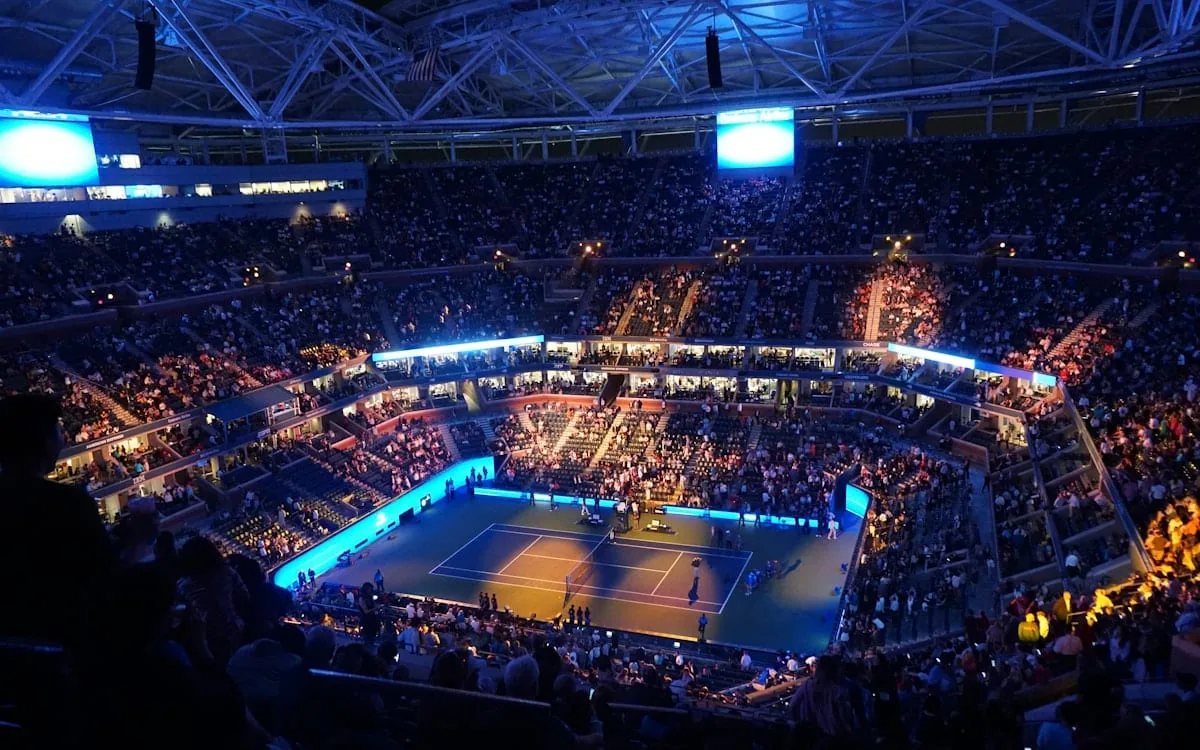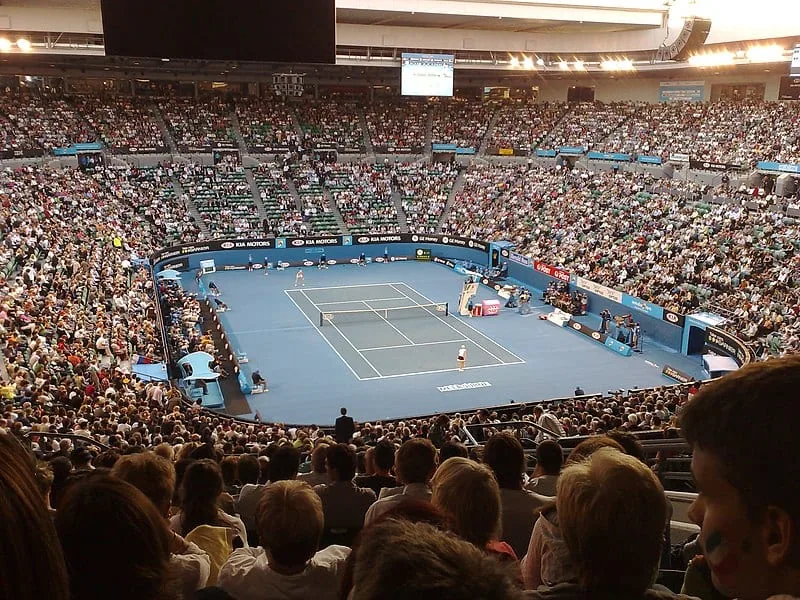
It is the third week of October, and professional tennis is happening in five places at once: Almaty, Lyon, Brussels, Ningbo and Osaka. Three of those are indoors under lights, two of them are eight time zones away from most of the people watching, and all of them are being broadcast into rooms where somebody is sitting alone with a laptop and whatever was in the fridge.
That is the honest shape of being a tennis fan. You are rarely in the stadium. You are in a kitchen, or on a sofa, half-watching a first round from Kazakhstan with a bowl of cereal at a time of day when cereal is not strictly appropriate.
Meanwhile, inside those arenas, thousands of people are eating. That is the part the broadcast never shows you, and it is one of the strangest gaps in how this sport reaches you. Tennis tournaments are, among other things, enormous catering operations. A Grand Slam feeds more people in a fortnight than most towns contain. And over a hundred-odd years, several of them have accidentally invented a signature dish or drink that fans now associate with the event as strongly as they associate it with any player.
Here is the useful bit: almost none of them are difficult. There is no technique in any of this that would trouble a reasonably confident twelve-year-old. You are not cooking for a restaurant. You are making one small thing so that a Tuesday night in your flat feels like it is connected to a stadium somewhere else.
So here is the season as a menu. Six stops, in calendar order, starting in January and finishing where this year finishes, in five weeks, in a city built on chocolate.
January, Melbourne: a dessert with a hundred-year head start
The Australian Open sells a soft serve called the Peach Melbourne. It is peach and vanilla swirled together and dusted with raspberry, it costs a few dollars, and in 2025 it sold a record 112,000 serves across the fortnight. It came back in 2026, scooped at Kia Arena, Show Court 3 and Topcourt, and the queues did not get any shorter.
The joke in the name is better than the ice cream, and the ice cream is good.
In the early 1890s, the French chef Auguste Escoffier was running the kitchen at the Savoy Hotel in London. Among the guests was an Australian soprano who was, at that point, roughly as famous as anybody on earth. She had been born Helen Porter Mitchell in a suburb of Melbourne, and when she needed a stage name she simply contracted the name of her home city. She became Nellie Melba.
Escoffier built her a dessert. The first version was peaches and vanilla ice cream presented inside a carved swan of ice, a nod to the swan in Lohengrin, which she had been singing. Later he simplified it, added a spoonful of sweetened raspberry puree, and named the result after her. Peche Melba.
So: a French chef, in a London hotel, names a dessert after a singer who named herself after Melbourne. A century and a bit later, Melbourne sells it back to the world as a soft serve at the tennis, in a plastic cup, in forty degree heat. That is a very long way for a peach to travel.
At home it is almost offensively easy. Ripe peaches if it is summer where you are, tinned peaches without apology if it is not. Good vanilla ice cream. Raspberries crushed with a little sugar and a squeeze of lemon until they slump into a sauce. Peach, then ice cream, then sauce poured over the top so it runs down the sides.
If you want to go further, the full Escoffier version is just vanilla ice cream churned properly, and an ice cream maker turns that into a twenty-minute job rather than an afternoon one. But the tinned-peach version in a cereal bowl at one in the morning, watching a five-setter from Melbourne that will not finish before three, is closer to the real experience anyway.
March, Indian Wells: the tournament in a date grove
The BNP Paribas Open sits in the Coachella Valley, in the California desert, and it has spent the last decade quietly becoming the best place to eat in professional tennis.
Nobu started as a pop-up there during the 2014 tournament and did well enough that it became a permanent restaurant inside Stadium 2 in 2023. You need a tournament ticket to get in, which produces the unusual situation of a world-famous restaurant whose front door is a turnstile. The wider 2026 food lineup ran to MOTO Pizza, Puesto, a duck-and-beef burger from the Michelin-starred Los Angeles kitchen Camphor, and plant-based sandwiches from a chef who has been feeding the desert for years.
But the thing to make at home is not any of that. It is the thing that grows outside the gates.
The Coachella Valley is date country. The groves run along the roads around the Tennis Garden, planted a century ago with palms brought from North Africa and the Middle East, and the local institution is not a restaurant at all but the date shake: dates blitzed with milk and ice cream until the whole thing turns the colour of wet sand and tastes like caramel that happens to be fruit. Shields Date Garden, a few minutes from the courts, has been selling them to tourists since long before the tennis arrived.
It is three ingredients. Medjool dates, stoned and soaked in a splash of warm milk for ten minutes so they soften. Cold milk. Vanilla ice cream. Blend until it is thick enough to make the blender complain. A decent box of medjool dates and any blender you already own will do it. Do not add sugar. The dates have handled that.
There is a reason to make one in the next three weeks, too. The WTA Finals were moved out of Riyadh this year and land at the Indian Wells Tennis Garden from 8 to 15 November, with the top eight players in the world in Stadium 1. It is the first time Southern California has hosted the women's season finale since 2005, and the venue was never built for November. If you want the background on how the finale ended up bouncing between continents, we traced the WTA Finals and its search for a permanent home earlier in the year.
Late May, Paris: champagne is not a treat, it is a default
At Roland Garros, champagne is reported to be the second best-selling drink on the grounds. Not the second best-selling alcoholic drink. The second best-selling drink, behind water.
Sit with that for a second. Every soft drink, every coffee, every beer in a plastic cup, and the thing Parisians reach for between sets is a glass of Moet. It tells you something about how the French Open understands itself. The tennis is ferocious and filthy, red dust up to the knees, rallies that go on past the point of cruelty, and the crowd watches it the way other people watch an opera.
The food follows the same logic. Crepe stands are a Roland Garros fixture, sweet and savoury, folded into paper and eaten standing up. The croque monsieur has a small and devoted following. There is a patisserie on site. None of it is stadium food in the sense that a hot dog is stadium food.
Crepes at home are the single highest-return thing on this entire list, because people believe they are difficult and they are not. Flour, eggs, milk, a pinch of salt, a little melted butter, whisked smooth and then left alone for half an hour so the flour can hydrate. That rest is the only rule that matters. The first one will be a failure. It is supposed to be. Every French household accepts the sacrifice of the first crepe as the cost of the other eleven.
A proper flat crepe pan makes the flipping far less dramatic, though a shallow non-stick frying pan works. Sugar and lemon, or butter and jam, or chocolate spread if you have no shame, which during a four-hour quarterfinal you should not.
Early July, London: the most famous ten strawberries in sport
A portion of strawberries and cream at Wimbledon costs 2.85 pounds in 2026. It went up fifteen pence from 2025, which itself was the first move in years after the club held the price at 2.50 for well over a decade. It is probably the only thing in Britain that has become more affordable in real terms since 2010, and the club is quietly proud of it.
What you get is at least ten Grade 1 British strawberries with cream poured over. They come from Hugh Lowe Farms in Kent, roughly half an hour down the road, picked and chilled overnight so they reach the grounds in the early morning before the gates open. Reports of the annual volume vary from about thirty tonnes to over fifty, depending on who is counting and which year, but all the numbers are absurd and all of them are gone in a fortnight.
The cream is the detail everybody gets wrong at home. Wimbledon pours cream. It is not clotted cream, not whipped, not a quenelle of anything. Cold pouring cream straight over cold berries, so it sits in the bowl and goes slightly pink at the edges. If you want the richer Devon version, a pot of clotted cream is a genuine upgrade, but it is an upgrade to a different dish.
The other half of a Wimbledon afternoon is Pimm's, and the numbers there are just as silly: over 314,000 glasses poured during the 2024 championships. A jug is one part Pimm's No. 1 to three parts lemonade, then cucumber in long strips, orange slices, strawberries, and a great deal of mint bruised between your palms first. Build it in a jug an hour before you want it so the fruit has time to do something. Serve it in tall highball glasses packed with more ice than feels sensible.
It does not taste like much on its own. It tastes like a specific fortnight in July, which is the entire point.
Late August, New York: the drink that bought the stadium
The Honey Deuce is the most successful piece of merchandising in modern tennis, and it is a cocktail.
In 2025 the US Open sold 738,459 of them, producing more than seventeen million dollars in revenue from a single drink. For 2026 the tournament held the price at twenty-three dollars and ordered 800,000 souvenir cups. There is a serious argument that the Honey Deuce now funds more of Flushing Meadows than some of the sponsorship does.
The drink itself was invented by the bartender Nick Mautone for Grey Goose, around the time the brand became the tournament's vodka, and the whole thing turns on one piece of visual wit. Vodka, lemonade, and a float of Chambord that sinks slowly through the glass in a pink column. Then three honeydew melon balls on a skewer across the top, sitting there looking exactly like three tennis balls in a can.
That is it. That is the entire idea, and it has earned a fortune.
To make it you need a melon baller, which is one of those single-purpose tools you will use twice a year and enjoy both times, and a bottle of Chambord raspberry liqueur. Vodka and lemonade over ice, then pour the Chambord gently down the inside of the glass so it falls rather than mixes, then the melon on top. Do not stir it. The sinking is the show.
We went deeper into where the drink came from and why it works in the full story of the Honey Deuce, including the recipe in proper measures.
Mid November, Turin: the season ends in a chocolate city
In five weeks the men's season finishes at the Inalpi Arena in Turin, from 15 to 22 November, for the sixth year running. Eight players, round robin groups, the last tennis of the year that genuinely matters. Who gets the eighth chair is still being argued over on hard courts across Europe this week, and we laid out how the race to Turin actually works if you want to follow the arithmetic.
Turin is a chocolate city, and most people watching the tennis have no idea.
Piedmont grows the Tonda Gentile hazelnut in the Langhe hills south of the city, and Turin's chocolate makers spent the nineteenth century working out what happens when you grind those hazelnuts into cocoa. The folklore says it began as a way of stretching scarce cocoa during Napoleon's blockade of continental trade, although the dates are argued over and the confection as we know it was being sold in the 1860s, handed out in gold foil at the city's Carnival. The result was gianduia, and its wrapped form, the gianduiotto, is still the thing you buy at Turin airport on the way home.
The city's other invention is better suited to a cold November evening in front of a screen. The bicerin is espresso, thick drinking chocolate and cream, layered in a small glass and never stirred. The name is Piedmontese for little glass. Caffe Al Bicerin, on the square in front of the Consolata church, has been pouring it since 1763, and Alexandre Dumas drank one there in 1852 and told everybody about it, which was the nineteenth century equivalent of going viral.
You need three things and no skill. Strong coffee, ideally from a stovetop moka pot, because a moka makes exactly the sort of bitter, slightly rough coffee this needs. Proper hot chocolate, thick enough to coat a spoon, not cocoa powder in milk. And lightly whipped cream, floated on top with a spoon.
Chocolate in the glass first, coffee poured slowly over the back of a spoon, cream on top. Resist stirring it. You are meant to drink through the layers so each mouthful is a different ratio. Add a couple of gianduiotti on the side and you have the taste of the city where this season ends.
The one rule that makes any of this work
Make it before the match, not during it.
This sounds obvious. It is the thing everybody gets wrong. Tennis has no clock, no half time and no natural break longer than ninety seconds, and if you leave the room to crush raspberries you will return to find the set gone. Build the jug, churn the ice cream, ball the melon, and then sit down. The changeover is for topping up, not for cooking.
The second rule, for anyone surviving the Asian swing or an indoor season that starts at odd hours in your time zone: match the food to the hour, not to the tournament. A bicerin at seven in the morning for a Ningbo quarterfinal is a perfectly defensible breakfast. A date shake at midnight is not. If the room itself needs work before you commit to a long winter of this, we went through how to set up a corner of your home for the indoor season in some detail.
And the third, which is less a rule than a warning: this gets out of hand quickly. It starts with strawberries in July and ends with you owning a melon baller, a moka pot and a bottle of Chambord with a centimetre left in it, because the season is eleven months long and there is always another tournament.
What you are really making
None of this is about the food. The food, with the exception of the chocolate, is mostly quite simple and occasionally beside the point. A soft serve is a soft serve.
It is about the fact that watching tennis alone is a slightly strange way to spend a life, and anything that puts you in the same sensory world as the people in the stands is worth doing. Twenty thousand people in Melbourne queuing for a peach ice cream in the heat, a Paris crowd drinking champagne out of plastic flutes between sets, a London fortnight that smells of cut grass and cream, a New York night session glowing pink through eight hundred thousand plastic cups. You cannot be there. You can taste what they are tasting, which turns out to be most of the way.
Pour something cold in May when the clay starts, and see if the room does not change.