The clocks in California went back this morning. For the next few weeks that one small adjustment will shape your evenings more than you expect, because it means the best tennis in the world is about to start happening either while you are asleep or while you are supposed to be working, depending entirely on which side of the Atlantic your sofa is on.
Welcome to November. It is the strangest month in the tennis year and, if you are the kind of person who loves watching this sport without ever picking up a racket, it is quietly the best one. Four tournaments, four weeks, four completely different flavours of pressure — and then, abruptly, nothing at all until the middle of January.
This is a guide to surviving it well. Not a training plan, not a betting preview. Just an honest map of what is coming, what time it lands, and the handful of unglamorous objects that turn a late night on the sofa from an endurance test into the thing you look forward to all day.
Four weeks, four tournaments, one long goodbye
Start with the shape of it, because November is dense in a way no other month is.
Paris, 2 to 8 November. The Rolex Paris Masters, played indoors at the arena out at La Defense in Nanterre, west of the city. This is the second year it has been staged there rather than at Bercy, and the move is still the main thing people argue about when the subject comes up — the old hall was cramped, dark and beloved; the new one is enormous and still deciding what kind of room it wants to be. We wrote about that move in detail in the Paris Masters without Bercy. For the men still scrapping for a place at the season finale, this is the last chance saloon.
Indian Wells, 8 to 15 November. The WTA Finals, the eight best women of the season, played outdoors in the California desert. This event has moved house more often than any other tournament in tennis, and this year it landed in the Coachella Valley at relatively short notice. Eight players, a round-robin group stage, then semi-finals and a final. If you want the full story of how it got there, it is in eight women, one desert week.
Turin, 15 to 22 November. The ATP Finals at the Inalpi Arena, the fifth straight season in the same Italian room. Same eight-player, two-group format as the women, same brutal logic: lose your first match and your week is already a maths problem. Who actually gets the eight chairs is still being settled in Paris this week, and we laid out how that qualification race works in the race to Turin.
Bologna, 24 to 29 November. The Davis Cup Final 8, with Italy as both host nation and defending champion after beating Spain in last year's final in the same city. Eight countries, knockout ties, a crowd that behaves nothing like a tennis crowd.
Then it stops. The women's team event, the Billie Jean King Cup, already had its finals week back in September in Shenzhen, so there is no December counterweight. After Bologna the courts go quiet, the players vanish to Dubai and Florida and the Gold Coast to run up hills, and the sport simply is not on television any more. If that sounds unbearable, we have been through what actually happens in where tennis goes in December.
So: four weeks of almost continuous tennis, and then a silence. It is worth setting yourself up properly for it.
The hours, honestly
Here is the part nobody tells you kindly.
From today, California is eight hours behind the UK and nine behind most of western Europe. During the Indian Wells week that is unforgiving arithmetic. A late-morning start in the desert is a perfectly civilised early evening in London. But the night session — the one with the lights on and the desert cold coming in and the atmosphere that makes the place worth watching — starts in California at an hour that puts it somewhere around three in the morning in Britain and four on the continent. On the American east coast it is a reasonable late evening. In Australia and Asia it is the middle of a working day.
Then the whole thing flips. Turin and Bologna run on European evening time, which is comfortable if you are anywhere between Lisbon and Warsaw and awkward everywhere else: a European night session is late afternoon in New York, a dawn raid in Sydney.
The practical consequence is that you cannot watch all of it live, and trying will make you miserable by about the eighteenth of the month. The trick that works is to decide, at the start of each week, which two or three sessions you are going to stay up for properly and which ones you will catch up on afterwards. Then protect the ones you chose. A planned 3am is a treat. An accidental 3am on a Tuesday, when you did not even mean to still be awake, is just a bad night's sleep with tennis attached to it.
If you are going to be watching things after the fact, be ruthless about avoiding the result. Mute the obvious words on social media for the month. Turn off sports notifications on your phone rather than trusting yourself to ignore them. There is nothing in tennis quite as deflating as a lock screen telling you how a match ended nine hours before you sit down to watch it.
Sound matters more than picture
If you only change one thing about how you watch tennis at home, change the sound.
Tennis is an unusually quiet sport and almost all of its information arrives through your ears. The difference between a ball struck clean and a ball struck late is audible long before it is visible. The intake of breath from fifteen thousand people when a rally goes past twenty shots is the whole reason to watch live. The scrape of a shoe changing direction tells you someone is in trouble. A small television speaker flattens every bit of that into mush.
For the late sessions, a set of wireless over-ear headphones is the single most useful object in this entire article. It lets you watch the desert night session at full volume at four in the morning without waking anyone, and it puts you inside the room in a way that no amount of screen size can. Over-ear rather than in-ear, if you have the choice — you may be wearing them for three hours and ears get sore.
For the sociable hours, when the house is awake and nobody minds, a small portable Bluetooth speaker parked behind the sofa does more for atmosphere than most people expect. Tennis crowds are mostly ambient noise, and ambient noise needs air to move in.
One more sound note, and it is heresy to some people: you are allowed to mute the commentary. Try one set of a Turin group match with the broadcast sound only — the ball, the crowd, the umpire calling the score — and see how differently the match reads when nobody is telling you what to think about it. Plenty of people never go back.
The picture, without overthinking it
You do not need a new television. You almost certainly need a better way of getting tennis onto the one you have.
Where the rights sit varies enormously by country and changes most years, and the four November events are not always on the same service as each other — which is precisely why a cheap 4K streaming stick earns its keep. It lets you put whichever app holds the tennis where you are onto a screen you already own, without replacing anything. Check which service carries each of the four events before the week starts rather than at five past the hour on the night.
A small thing that makes a surprising difference: plug the stick in and run the app once, in daylight, a day early. App updates, forgotten passwords and two-factor codes sent to an email you cannot open are the classic way to miss a first set.
Warmth, and the specific problem of the small hours
Watching sport at three in the morning is a physically different activity from watching it at eight in the evening. Your body temperature drops. The heating has gone off. The room that was fine four hours ago is now genuinely cold, and being cold is the single most common reason people give up on a night session and go to bed before the third set.
A proper heavy throw blanket that lives on the arm of the sofa for the whole month is not an indulgence, it is equipment. So is something hot that does not require you to leave the room mid-tie-break. Make it before the match and keep it in an insulated flask; a kettle boiling at two in the morning is both loud and a guaranteed way to miss the best rally of the match. If you want to be properly civilised about it, a decent loose-leaf black tea made once and kept warm beats four separate trips to the kitchen, and it is a nicer ritual than it has any right to be.
On light: do not watch in the pitch dark. A single warm dimmable lamp behind or beside you, set low, keeps your eyes from aching and makes a 3am session feel deliberate rather than furtive. There is a real psychological difference between a room arranged for watching something and a room you happen to be awake in.
And if you are eating — and you will be eating, because 3am — a lap tray is the unglamorous hero of the whole operation. It stops the inevitable spill, it holds the phone and the flask, and it means you are not leaning forward over a coffee table for two hours and wondering the next day why your back hurts.
Keep a notebook, because the group stage is a puzzle
This is the one piece of genuine homework in the month, and it is the part that turns a casual viewer into someone who actually understands what they are watching.
Both the WTA Finals and the ATP Finals use a round-robin group stage: two groups of four, everybody plays everybody once, the top two in each group go through to the semi-finals. It sounds simple. It is not, because matches are not knockouts and so results stop being binary. Games and sets you lose in a match you win still count.
The standard order of tiebreakers runs like this. Most matches won comes first. If two players are level there, the head-to-head between them decides it. If three players finish level on two wins each — which happens more often than you would think — it goes to the percentage of sets won across all three matches, and if that is still tied, to the percentage of games won. Which is why a player who is already beaten in a dead rubber will sometimes fight like a lunatic to take four more games off an opponent, and why a straight-sets win on the Tuesday can still be doing quiet work for you on the Friday.
All of which means the third round of group matches is frequently the best viewing of the week, and also that you genuinely cannot follow it in your head. A cheap lined notebook with the eight names down the side and the scores written in as they happen is worth more than any app. Keep it on the lap tray. By the Thursday you will be the person in your household who knows that someone needs to win in straight sets, and there are few cheaper pleasures than that.
Negotiating with the people you live with
A month of tennis is a lot to ask of anyone who does not care about tennis, and the households where this goes well are the ones that are honest about it early.
The headphones solve most of it. Beyond that, the thing that works is naming the handful of sessions that actually matter to you — a final, a group decider, the night your favourite plays — and being relaxed about the rest. Four weeks of tennis is not four weeks of essential tennis. There is a reasonable amount of filler in there, and pretending otherwise is how you end up watching a dead rubber alone at two in the morning while somebody upstairs quietly reconsiders the relationship.
And if there is anyone in the house who might be tempted in: Bologna is the week to try them on. Which brings us to the odd one out.
Davis Cup is a completely different animal
Everything above is written for the individual game. The last week of November is not the individual game.
The Davis Cup Final 8 is knockout ties between countries, played best of three matches — two singles and a doubles — in an arena full of people who have travelled to sing. It is louder, cruder and far more emotional than anything else on the calendar. Players who are glacial for eleven months of the year shout at the ceiling. There is a captain on a chair at the side of the court, allowed to talk to them between points, which is the only time all season you hear what coaching actually sounds like.
Italy are both the hosts and the holders, which means Bologna will be the loudest room in tennis all year, and the home ties will feel less like a tennis match than a football night that happens to involve rackets. If you have ever tried to explain to a sceptical friend why this sport is worth caring about and failed, do not start them on a group match in Turin. Start them here.
What it actually looks like
By the end of the month you will have watched a Masters 1000 in a vast new French arena that is still working out its personality, eight women decide a season in the desert, eight men do the same under a roof in Turin, and eight countries shout at each other in Bologna. You will have seen somebody cry. You will have seen at least one match that goes to a third-set tie-break at a stupid hour and that you will still be describing to people in March.
And then, on the thirtieth of November, it will be over. The Inalpi Arena will go dark, Bologna will start packing up the temporary stands, and the flat will be quiet in a way it has not been for four weeks. You will fold the blanket and put it back in the cupboard. Somewhere in the middle of December, out of nothing but habit, you will pick up the remote at ten past seven, scroll for a while, and find there is no tennis anywhere at all.
That is the month. Set the sofa up properly and it is the best one of the year.
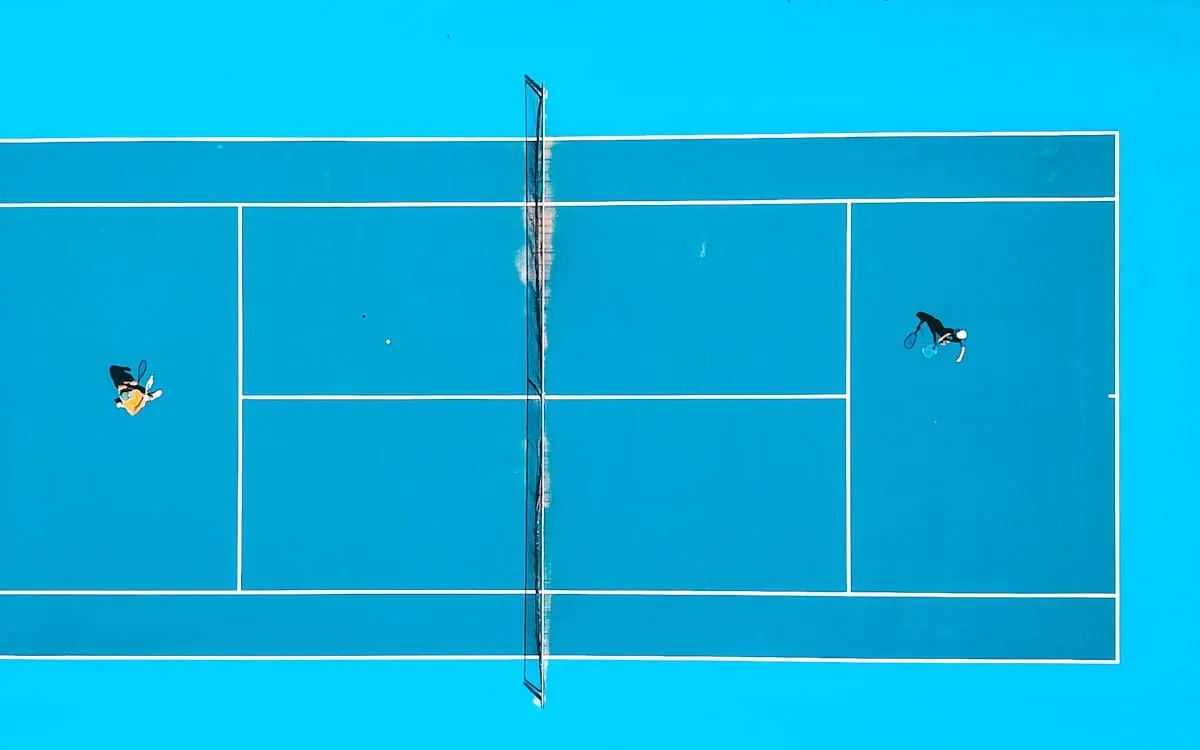
Photo: white and pale blue lines on a hard court, from our picture library.