If you are Australian and awake, you already know. If you are not, here is what slipped past while the Laver Cup at the O2 and the Billie Jean King Cup Finals in Shenzhen were eating all the headlines this weekend: on one Sunday, in two Asian cities, three Australian women are playing for tour-level titles.
In Seoul, Kimberly Birrell plays Maya Joint for the Korea Open. It is the first all-Australian final on the WTA Tour since 2017, which means that whatever happens in the next two hours, Australia gets a champion today.
In Singapore, a few hours later and a few thousand kilometres south, Talia Gibson walks out at the OCBC Arena for the first tour-level final of her life, against a former US Open finalist.
Three players, two finals, one afternoon. For a country that has spent four years wondering what its women's game looks like after Ash Barty, that is not a coincidence. It is a scoreboard.
Seoul: the final nobody had pencilled in
Start with the one that is historic.
The Korea Open is a WTA 250, the smallest rung on the tour ladder, played on hard courts in Seoul in the last week of September. It is the kind of event that lives in the gaps of the calendar, where players outside the top fifty go to fix a season or start one. This year the weather made it worse: rain turned the week into a backlog, and by Saturday the survivors were playing twice.
Kimberly Birrell played two three-set matches in a single day. First she came from a set down to beat the American Katie Volynets. Then, with barely time to change her shirt, she went back out and beat the sixth seed Anna Bondar 7-5, 2-6, 6-1 in two and a half hours. That is roughly five hours of tennis on one Saturday, at the end of a long season, to reach a final.
Maya Joint had a gentler route into it. Her semifinal against Alevtina Korneeva lasted 49 minutes before Korneeva retired, with Joint leading 6-1, 1-0. Sometimes the draw is kind. Given what her year has looked like, she will take it.
So: Birrell, 28, ranked in the mid-fifties, in the third tour-level final of her career and still without a title. Joint, 20, ranked just outside the top hundred, in her third final having won the first two. They have never played each other on the main tour.
The last time two Australian women met in a WTA final, it was Strasbourg in May 2017: Sam Stosur beat Daria Gavrilova 5-7, 6-4, 6-3 in a match that ran to nearly three hours and kept Stosur at the top of the Australian rankings, a position she held for 451 consecutive weeks. Gavrilova went to a career high of 24. Stosur picked up her ninth trophy. Both of those players have since retired from singles.
Nine years is a long time between drinks.
Thirty months, two surgeries, six matches
To understand why Australians were slightly emotional about Saturday's result in Seoul, you have to know what Kimberly Birrell has already spent.
In January 2019, aged 20, she had the run that announces a career: a wildcard into the Australian Open who beat Paula Badosa and then Donna Vekic to reach the third round in front of a home crowd that could not believe its luck. She looked like the next one. Everybody said so.
Then her right elbow went. Two operations. Between July 2019 and January 2022 — thirty months — she played six tour-level matches. An eighteen-month layoff, then an eleven-month one. Her ranking fell to 669 in the world, which is not a ranking so much as a filing error, a number that means you are paying to travel to tournaments where nobody is watching.
She has said, plainly, that she thought her career was finished.
The way back was slow and unglamorous. Qualifying draws. ITF events in cities you have to look up. A wildcard into Australian Open qualifying at 669 in the world. In 2023 she got a main-draw wildcard at Melbourne Park almost by accident, when Venus Williams withdrew injured and a spot opened up.
From there: a first tour final at Osaka in 2024, reached as a qualifier, lost. A second at Chennai in 2025, lost. A career-high ranking of 60 in May 2025. And now Seoul, at 28, with the trophy on the table and a top-fifty ranking waiting on the other side of it.
Players who lose thirty months do not usually come back. The ones who do rarely come back to the same level, because the body has changed and the ranking has gone and the money has run out while the years kept moving. Birrell came back to a better level than she left. That is the part worth sitting with while you watch her serve at 4-4 in a third set.
The 20-year-old on the other side of the net
Maya Joint is the strangest and most interesting Australian in the game right now, partly because she was not always Australian.
She was born in Grosse Pointe, Michigan, in April 2006, to an Australian father and a German mother, and she held both passports from birth. She grew up hitting balls with a squash racquet on public courts in the American Midwest. In 2023, at 17, she chose her father's country, moved to Brisbane and joined the national academy. She had a place at the University of Texas lined up for the 2024-25 college season and, that December, gave it up to turn professional instead.
The year that followed made her look like a prophet. Her first tour title came in Rabat. Her second came at Eastbourne, on grass, where she saved four championship points against Alexandra Eala and won 6-4, 1-6, 7-6(12-10) — the first Australian woman ever to win that tournament, and the first even to reach the final since Wendy Turnbull in 1983. She finished 2025 at a career high of 32, became Australia's top-ranked woman, and in January was the first Australian woman seeded at her own Grand Slam since Barty in 2022.
Then 2026 happened. Illness in the opening week at the United Cup. A serious back injury at Indian Wells. A season that never found a rhythm, 16 wins against 22 losses, a ranking sliding back towards three figures.
And in the middle of it, the single most watched match of her life. At Wimbledon in July, on Centre Court, she drew Serena Williams — 44 years old, playing her first Grand Slam singles match since the 2022 US Open, in front of a crowd that had come to see a resurrection. Joint won 6-3, 6-7(5), 6-3. She saved the moment, held her nerve through a second-set tiebreak that got away from her, and converted her third match point. Serena walked off to an ovation. Joint walked off having beaten a seven-time champion of that tournament at the age of 20.
A season can contain both of those things: the biggest win imaginable and a losing record. That is tennis, and it is why the ranking list is a poor guide to who is actually dangerous.
Two finals, two titles, so far. A third today.
Singapore: the strangest way to reach a first final
Four hours south, the story is simpler and happier and has one awkward edge.
Talia Gibson is 22, from Perth, and started this season ranked 118 in the world with a stated goal of reaching the top 100. She got there in March. By mid-May she was at 55, a career high, which is the kind of jump that changes what your year looks like: direct entry instead of qualifying, better practice courts, a coach who can afford to travel with you for thirty weeks instead of ten.
Singapore is a WTA 500, a genuine step up from Seoul in prize money and field quality, and Gibson has had the week of her life in it. In the quarterfinals she beat Maria Sakkari, the seventh seed, 6-1, 4-6, 6-2, taking the first set in a rush, absorbing the inevitable comeback, and then pulling away again in the decider after nearly two hours. It was her first WTA 500 semifinal.
The semifinal itself never happened. Her opponent, Tatiana Prozorova, withdrew with a concussion sustained playing doubles, and Gibson was given a walkover into the final.
It is a hollow way to reach the biggest match of your career, and nobody pretends otherwise — least of all the player who gets the free pass and then has to sit for 36 hours with the nerves and no match rhythm. Prozorova deserves better than a footnote; a head injury picked up in a doubles match is a rotten reason to miss your first big final.
What Gibson has to do with it is play Leylah Fernandez, who has had her own kind of week. The Canadian, who reached the US Open final in 2021 as a 19-year-old and has spent the years since being told she should have kicked on, is in her first final of the season. To get here she beat the top seed Mirra Andreeva 6-2, 7-5, and then came back from 1-6 down in the first set to beat Maja Chwalinska, this year's French Open runner-up, 1-6, 6-4, 6-2.
They have never played. Fernandez has the bigger name, the bigger occasion behind her and the better week of form. Gibson has the thing that is hardest to plan for, which is a player who has just found out what she can do.
Win or lose, Gibson is projected into the top 40 on Monday. In January she was 118.
What Australia has actually been waiting for
Here is the number that gives today its weight: no Australian woman has won a tour-level singles title in 2026.
Not none at all — Daria Kasatkina, who began representing Australia in 2025 and took citizenship this year, won the Catalonia Open in May, her first title under the new flag, although that is a WTA 125 and sits a tier below the main tour. Olivia Gadecki won the Australian Open mixed doubles with John Peers in January, defending the title they won together the year before. Joint has doubles trophies from Monterrey and Abu Dhabi this season.
But a WTA Tour singles title, the thing that puts a name on the honour board, has not gone to an Australian woman all year. The last one was Joint at Eastbourne in June 2025.
That is the context for a two-Australian final. It is not just a pleasant statistical curiosity; it is a guarantee that the drought ends this afternoon, whichever of them wins, and a real chance that it ends twice before midnight.
Something else is going on underneath, too. The Australian women's game after Barty was expected to have one obvious successor. Instead it has a cluster: Joint at 20, Gibson at 22, Birrell at 28 with the hardest miles of anyone, Kasatkina rebuilding after ending her 2025 season early to look after her mental health, Gadecki, Taylah Preston coming through behind them. Depth is less romantic than a single superstar, but it is far more durable, and it produces Sundays like this one. A country with one great player has one final a year. A country with eight good ones has weekends where two of them run into each other.
If you want a sense of how much of the season is still to be decided in this part of the world, the autumn stretch after the US Open is where a lot of rankings get made and unmade — and the Billie Jean King Cup Finals in Shenzhen have been running alongside all of this.
Why September in Asia decides so much
For the players in the fifty-to-hundred band, the Asian swing is the most valuable month of the year, and it has very little to do with glamour.
The maths is simple. Ranking points expire twelve months after you earn them. Players in this range earned very few points last autumn, because last autumn most of them were losing early or playing ITF events, which means there is almost nothing to defend and everything to gain. A single good week in Seoul or Singapore can be worth more to a ranking than a heroic loss to a top-five player in March.
The draws are smaller, too. A WTA 250 is a 32-player draw. You need four wins for a final instead of six, and the top-ten players are usually somewhere else, saving themselves for Beijing and Wuhan and the year-end race. If you are ever going to win a title, this is the month it happens.
And the schedule keeps escalating. Next week the tour moves up to Beijing, where the women's event runs from 30 September to 11 October at the National Tennis Center, a huge draw with the very best players in it. After that, Wuhan, Ningbo, and the long run towards the WTA Finals in November. Today is the last week where a player ranked 56 in the world has a clear road to a trophy.
Birrell, Joint and Gibson all took that road. Two of them got to the end of it.
Last week this same Singapore draw had Amanda Anisimova in it, which tells you how the field has thinned and reformed across the swing as the big names pick and choose.
What to watch for this afternoon
In Seoul, watch the third set, if it gets there. Birrell has played roughly five hours of tennis in the last 48. Joint has played 49 minutes. In a best-of-three on a hard court, that gap tends to show up somewhere between 3-3 and 5-5 in a decider, in the length of the rallies one player is willing to accept.
Watch Birrell's forehand when she is nervous, too. It is the shot that carried her through the Bondar match and the shot that will tell you, one way or the other, how she is handling the idea of a first title at 28.
In Singapore, watch the first four games. Gibson has not played a competitive match since Thursday and will walk out cold against an opponent who has just beaten the world number one seed and come back from a set down in a semifinal. If she is still on serve at 2-2, she is fine. Fernandez's whole game is built on making you play one more ball than you want to; young players who have never been in a final tend to find out about that in the first ten minutes.
And if you are somewhere the broadcast does not reach, the scoreboards will do. There is a specific pleasure in refreshing a live score from a tournament you had not thought about all year, because of a player you had not thought about all year, and finding that the match has gone to a third set.
The part nobody films
Set an alarm if you want. Or do not, and let the results be waiting for you tomorrow morning like a small present.
But if you have ever wondered what the middle of a tennis career actually looks like — the years between the junior hype and the retirement tribute, the part that no documentary crew turns up for — it looks like this. It looks like a 28-year-old from the Gold Coast who lost thirty months of her twenties to an elbow that would not heal, walking onto a court in Seoul on a Sunday afternoon with a trophy she has never won sitting on a table beside the net, across from a 20-year-old who chose to be Australian and has already beaten Serena Williams.
Neither of them is famous. Both of them are about to be, in one small country, for one very good weekend.
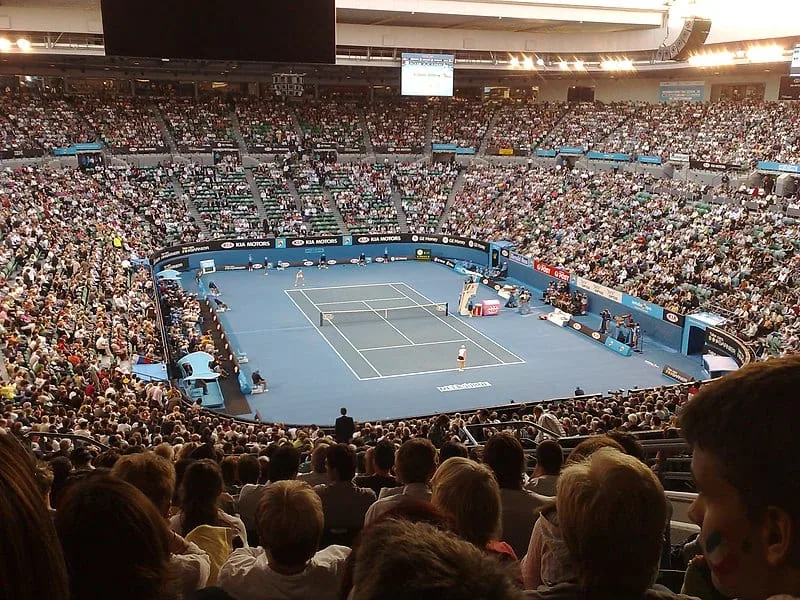
Photo: Melbourne Park during the Australian Open, from our picture library.
🎾 Gear from this story
WilsonWilson Blade SW 104Serena Williams's racket of choiceView on Amazon →As an Amazon Associate, SUPER.TENNIS earns from qualifying purchases.