The biggest week of the women's tennis year does not have an address.
For most of the last decade it has been a travelling circus with a trophy: a different city almost every autumn, a different continent, twice a different hemisphere, and often an announcement so late that even a devoted fan could not have booked a flight in time. If you have ever tried to explain to a friend where the WTA Finals is this year, you will have noticed yourself hesitating. That hesitation is the whole problem.
Last Wednesday, in a press conference in North Carolina with no tennis being played anywhere near it, that finally changed.
What was actually announced
On 16 September the WTA and the Charlotte Sports Foundation confirmed that the WTA Finals will be held at the Spectrum Center in Charlotte in 2027, 2028 and 2029. The Spectrum Center is the downtown arena the NBA Hornets play in, a building that seats about 19,000 for basketball and rather fewer once a tennis court and its run-off are dropped into the middle of it.
The event itself is the season-ending championship: the eight best singles players of the year and the eight best doubles teams, round-robin groups first so nobody goes home after one bad afternoon, then semi-finals and a final. No qualifying, no first-round bloodbath, no early-round filler. Every match is between two players who have earned their way into the room. It is, on paper, the easiest week in tennis to sell.
The 2027 edition is listed in the state paperwork for 10 to 14 November, with officials projecting attendance across the week of around 80,000.
The second half of the announcement is the part that will matter longer. The WTA is moving its global headquarters to Charlotte from St Petersburg, Florida. The organisation that runs women's tennis will live in the same city as its showpiece event, which has not been true for a very long time.
North Carolina put in 14.4 million dollars through its Major Events, Games and Attractions fund, the largest single award in that program's short history. The city of Charlotte and Mecklenburg County added 2.5 million dollars each. And there is a carrot dangling past 2029: if a tennis-specific venue gets built in the city, Charlotte becomes eligible to host an annual WTA 500 event, the tier just below the 1000s.
That is the news. Here is why it is a bigger deal than a venue announcement usually is.
The best format in tennis, and hardly anyone sees it
If you have never watched this week, it is worth knowing what you have been missing, because the shape of it is unlike anything else in the sport.
The eight singles players are split into two groups of four. Everybody plays three matches. The top two in each group go through to the semi-finals. That one change, from knockout to round-robin, rewires the whole thing. A player can lose on the Sunday and win the title on the Saturday. Nobody flies home after ninety bad minutes, which means nobody plays those tight, fearful opening matches you get in the first week of a major.
By the middle of the week it turns into arithmetic. Win in straight sets and you are through; lose 7-5 in the third and you might still go through on sets won, or games won, or on what happens in the last match of the group that evening. Players sit in locker rooms watching other people rally for their fate. Commentators start drawing tables on paper. It is the only week of the year when tennis feels a bit like a World Cup group stage, and it is enormous fun once you understand the sums.
The doubles matter here too. The eight best teams of the year play in the same arena on the same days, in front of the same crowd, rather than being shuffled onto an outside court while everyone queues for the singles. For one week, the best doubles players in the world get watched properly.
And there is the look of the thing. Indoors, in November, one lit court in a dark bowl, no wind, no sun, no excuses. Every ball comes back the way it was struck. The tennis is usually superb. The difficulty has only ever been persuading enough people to be in the building.
The wandering years
Go back far enough and the women's season used to end in the same place every year, and everybody knew it. Madison Square Garden hosted the season finale for most of the late seventies, the eighties and the nineties, right through to 2000. New York in November, the Garden, the last tournament of the year. You did not have to look it up.
Then it left, and it has been looking for somewhere to live ever since. Munich in 2001. Los Angeles from 2002 to 2005. Madrid. Doha. Istanbul. Then Singapore from 2014 to 2018, which is the last time the event genuinely felt settled: a purpose-built indoor stadium, a city that treated it as a civic occasion, and an announced attendance of 133,000 across the week in 2017.
In 2018 the WTA signed what looked like the end of the search: a ten-year deal to stage the Finals in Shenzhen from 2019 to 2028, with prize money doubled to 14 million dollars, the richest purse in women's tennis. Shenzhen hosted once. Then the pandemic wiped out the 2020 edition entirely, and the relationship with China collapsed in 2021 when the tour suspended its Chinese events over the safety of Peng Shuai, the former doubles world No. 1 who accused a senior official of sexual assault and then largely disappeared from public view.
So the Finals became a lodger. Guadalajara in 2021. Fort Worth in 2022, in the handsome 14,000-seat Dickies Arena, on so little notice that the marketing never got going: the opening day was played in front of an arena less than a tenth full, and by day two organisers had cut some tickets to six dollars. Iga Swiatek, who was world No. 1 at the time, publicly hoped out loud that the crowds might pick up.
Then Cancun in 2023, which is the one people still wince about. The event was confirmed less than two months before it started, after negotiations elsewhere fell apart. The court was built at a resort, on ground that had been a golf course, and it was not ready in time for the players to practise properly on it. Aryna Sabalenka, then the world No. 1, said the conditions were another level of disrespect and that players did not feel safe moving on the surface. Rain and wind hammered the week; the final had to be pushed back a full day. The players association asked for an independent review. The WTA conceded, in the end, that it had not been a perfect event.
Then Riyadh in 2024 and 2025, on a three-year contract with the Saudi Tennis Federation and the richest prize fund the event had ever carried, which drew loud objection from Chris Evert, Martina Navratilova and John McEnroe among others, and equally loud defence from a tour that badly needed the money.
And then this year, the swerve. In July the WTA asked to move the 2026 edition out of Riyadh, ending the deal a year early by mutual agreement, with reporting at the time pointing to the escalating conflict in the region. Which is how the 2026 WTA Finals ended up in the California desert.
Count them from 2019: Shenzhen, Guadalajara, Fort Worth, Cancun, Riyadh, Riyadh, Indian Wells. Six cities, seven editions, four continents, one cancelled year. No wonder nobody can remember where it is.
What homelessness actually costs
It is tempting to file all of that under administration. It is not. It is the reason the best week of women's tennis has, for years, been the hardest week of women's tennis to love.
A tournament with a home gets a date in the diary. People book the same week off work. A local schools programme develops. Bar staff and ushers come back year after year and learn the sport. Season-ticket holders at the arena start buying the tennis too, because it is their building. The city learns to put the players' faces on the side of buses. Children who came aged nine come back aged twelve and bring a friend.
A tournament without a home gets none of that. It arrives, it plays, it leaves, and the following year the whole exercise starts again in a city that has had four months' notice. That is why the television pictures from Fort Worth showed empty bowls of seats behind two of the best players alive, and why the pictures from Cancun showed umbrellas. It was never about the quality of the tennis. Swiatek against Sabalenka is Swiatek against Sabalenka wherever you stage it. It was about everything around the tennis, which is the part that makes a week feel like an occasion instead of a fixture.
The men's equivalent has spent those same years doing the opposite. The ATP Finals settled in Turin in 2021 and has stayed there, and the result is a November week that sells out, fills a city centre, and has become part of the Italian sporting calendar in a way no amount of prize money could have bought in a single edition. You can read more about how the autumn stretch of the season works in our guide to what happens after the US Open, but the short version is that the last six weeks of the year only really work when the finish line is somewhere people can find.
Why Charlotte
The obvious question is why a city with essentially no professional tennis history got it.
The honest answer is that Charlotte wanted it more than anywhere else did, and was prepared to be specific about that in public money. Nearly 20 million dollars in combined state, city and county support is a serious commitment for a five-day event, and North Carolina has effectively decided that a tour headquarters plus a marquee championship is worth the outlay in visitors, hotel nights and the harder-to-measure business of being the sort of place that global sports bodies live.
There is also a small track record that makes this less strange than it looks. Since 2024 the Spectrum Center has hosted an exhibition event that has pulled in names like Carlos Alcaraz, Frances Tiafoe and Venus Williams, and it sold. The building knows how to put down a court and fill the seats around it. The city has spent 2026 collecting corporate relocations, and the WTA is the fifth headquarters it has landed this year. Charlotte's only prior claim on the women's tour is a small event in the mid-1970s, which is to say none at all.
There is a duller reason too, and it is probably the decisive one: clocks. A season finale in Shenzhen or Riyadh is a tournament that finishes in the small hours for the biggest television market in tennis. Put it on the American east coast and the evening matches land in prime time across the Americas, with Europe picking them up late at night rather than not at all. Women's tennis in the United States has spent a decade selling out arenas for one fortnight in New York and then vanishing from the schedule until March. A fixed November week in an eastern-time arena is the tour trying to buy back the eight months in between.
And there is a nice piece of symmetry buried in the arithmetic. The last time the season-ending championship had a multi-year home in the United States, it was at Madison Square Garden and it ended in 2000. Charlotte 2027 would be the first time in more than a quarter of a century that American fans could treat this week as an annual fixture rather than a rumour.
Whether the money matches Riyadh is the open question nobody has answered yet. The Saudi editions carried a prize fund north of 15 million dollars, more than the singles champion of any major except the US Open takes home for two weeks of work. If Charlotte cannot hold that line, the players will notice, and quickly. If you want a sense of how that money actually lands in a player's bank account, we went through where tennis prize money goes earlier this year, and the answer is that far less of it stays than you would think.
Before any of that: the desert, this November
None of the Charlotte news changes what happens in seven weeks.
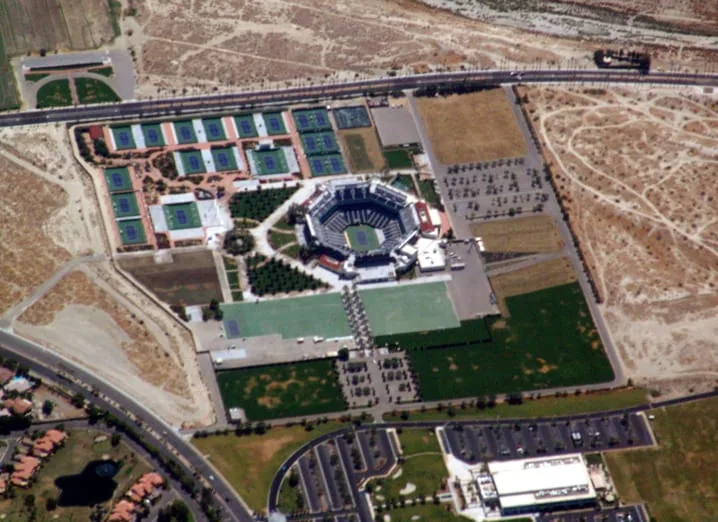
The 2026 WTA Finals will be played at the Indian Wells Tennis Garden from 8 to 15 November. It is a proper tennis site: a purpose-built complex in the desert outside Palm Springs, with a main stadium seating around 16,000, warm days, cold evenings and a crowd that already knows the sport because it turns up for the big March event every year. It is the first time the women's season has finished in Southern California since Los Angeles in 2005.
The race to get there is most of the way run. Elena Rybakina leads it comfortably after winning the US Open, beating Sabalenka 6-4, 5-7, 6-2 in the final, and rising to world No. 1 for the first time on 14 September. As of 21 September she had 7,492 points in the Race to the Finals, with Sabalenka on 6,485. Rybakina became the first player to mathematically confirm her place in Indian Wells during that run in New York.
Behind those two there is a genuine scramble for the remaining places through the Asian swing and the indoor autumn, which is why the next six weeks of tennis are worth paying attention to even when the tournaments have unfamiliar names. Some of those matches are happening right now: the Billie Jean King Cup Finals are being played in Shenzhen this week, which is its own strange echo, given that Shenzhen was supposed to be hosting this very championship until 2028. We wrote about the Kazakh team there and how a country builds a tennis nation from almost nothing yesterday, and about Amanda Anisimova starting her autumn in Singapore earlier in the week.
The part that is easy to miss
There is a version of this story that is entirely about money: a state fund, a bidding process, a tour looking for stability after a decade of improvisation and one very lucrative, very contested detour. All of that is true.
But the thing a permanent home gives a sport is not financial. It is the ability to make a promise. The second week of November, this building, these eight players, every year for three years. That is enough for a family in Raleigh to make it a tradition. It is enough for someone in Atlanta to decide that this is the year they finally see Sabalenka hit a forehand in person. It is enough for a nine-year-old with a racket in the garage to be taken to something.
Tennis has spent a decade treating its season finale as an asset to be auctioned and has been surprised, repeatedly, when the pictures came back half empty. The audience was never the problem. The audience was simply never told, early enough and in the same place twice, where to turn up.
In November 2027, somebody in Charlotte will buy a seat for a mid-November evening without yet knowing which two players will be standing on the court. They will buy it because the tennis is in town that week, the way it is every year. That small, ordinary, deeply unglamorous act is what the last ten years have been missing, and it is worth 14.4 million dollars of anybody's money.
Photo: the Indian Wells Tennis Garden from the air, from our picture library.
🎾 Gear from this story
WilsonWilson Blade 104Aryna Sabalenka's racket of choiceView on Amazon →As an Amazon Associate, SUPER.TENNIS earns from qualifying purchases.