At about eleven o'clock at night, when the last match on the last court has finished and the crowd is shuffling towards the taxi rank, there is one room at every big tennis tournament where the lights are still on and nobody is going home.
It usually has no windows. It is usually tucked behind the players' restaurant, down a corridor you would never be allowed to walk along, and it sounds like nothing else on the site: a low mechanical whirring, the tick of a tension head pulling and locking, and every few seconds a sharp snap as a clamp comes down. A dozen or more people are standing at waist-high machines. In front of each of them is somebody's racket, held by the throat, frame stripped bare, being rebuilt from nothing.
This is the stringing room. You have probably never seen a photograph of one, because there are almost none. And it is, in the most literal sense, the place where professional tennis is made. If it shut for a single day, the tournament would shut with it.
Six hundred in a day
Start with the numbers, because they are hard to believe the first time you meet them.
At Wimbledon, where Babolat has been the official stringer of The Championships since 2022, the team gets through more than six thousand rackets across the fortnight. On the heaviest days — the opening Monday and Tuesday, when all one hundred and twenty-eight players in each singles draw are still alive and the doubles, the juniors and the wheelchair events are stacked on top of them — demand regularly passes six hundred rackets in a single day.
Six hundred. One room. One day.
The US Open runs at the same pitch. On day one of the 2024 main draw, a team of just over twenty stringers processed five hundred and fifteen frames. At Wimbledon the room measures roughly a hundred square metres, and in the busy first week sixteen stringers work in it at once, from six in the morning until eleven at night. The full roster is drawn from something like twenty to twenty-five specialists who fly in from France, Brazil, Japan and the United States for the fortnight, because there are not enough people on any one continent who can do this at the required speed.
Which brings us to the speed. A racket strung properly — mains threaded, crosses woven, tension held, knots tied, stencil applied — takes about twenty minutes. A working tournament stringer will do thirty to forty of them in a shift. That is ten or twelve hours of standing at a machine doing fiddly, exacting handwork, with the clock running, on equipment that belongs to somebody whose entire year might be decided that afternoon.
Nobody out on court thinks about this. That is rather the point.
Why anyone needs six hundred rackets
The obvious question, if you follow tennis but have never picked up a racket in your life, is why. Strings look like strings. Why would a tournament need to replace six hundred sets of them before lunch?
Because modern strings are consumable in a way that the old ones never were, and because modern tennis eats them.
For most of the last century, the top of the game played with natural gut, which is exactly what it sounds like — a string spun from animal fibre, beautiful to hit with, warm and lively and forgiving, and expensive and fragile and hopeless in the rain. Then in the 1990s a Belgian company called Luxilon began producing polyester strings, and in 1997 a twenty-year-old Brazilian ranked sixty-sixth in the world turned up at Roland Garros with them in his racket and won the whole thing.
Gustavo Kuerten did not win because polyester made him hit harder. He won because polyester let him hit as hard as he liked without the ball flying long. Poly is stiffer and it grips the ball, so a full swing comes off with a violent amount of topspin — the ball leaves at a height that looks completely wrong, arcs towards the back fence, then dives. The Luxilon shot, people called it. Today it is simply how tennis is played, at every level above the local club.
The trade is that polyester dies. It loses tension quickly and it goes dull, and a player who swings hard enough to make it work can feel the difference within a couple of hours of hitting. Some of them can feel it within a set. That is why the bags you see being wheeled onto court hold eight or nine rackets rather than one, why a player will hand one to the ball kid and take a fresh one at a changeover, and why the bag goes straight back down the corridor to the windowless room the moment the match ends.
There is a second rhythm layered on top. New balls come out after the first seven games and every nine games after that, and fresh balls behave differently — livelier, faster off the string. Plenty of players change rackets at the ball change for exactly that reason, reaching for a frame strung a little tighter to keep a livelier ball inside the lines. If you have ever wondered why the game keeps arguing about its own tennis balls, this is part of the same conversation. Balls and strings are a system, and the players feel both ends of it.
Then add heat, humidity, altitude and a roof that opens and closes. Natural gut in particular hates damp air. A frame strung at nine in the morning for an outdoor court is not necessarily the right frame for the same court at nine at night under lights, and a player who has just watched their opponent's ball sit up in the evening air will send a racket back with a note asking for a kilo more.
Tension is personality
Here is the part that changes how you watch.
The number a player asks for is not a technical detail. It is a statement about who they are.
Novak Djokovic has played most of his career on a hybrid — natural gut in the mains, a Luxilon polyester in the crosses — at a reported tension somewhere around twenty-six to twenty-eight kilos, which is very tight. Tight strings do not give you free power. They give you control and feel, a flat and precise ball, and they demand that you generate everything yourself. It is a setup for a player who wants the racket to do exactly what he tells it and nothing else.
Jannik Sinner is reported up around twenty-eight kilos too, in a full polyester setup. That is a wall. It suits the way he plays, which is to stand on the baseline and hit through the court with a ball so flat and heavy that opponents describe it less as a rally and more as a queue of problems.
Carlos Alcaraz sits lower, in the region of twenty-four to twenty-five kilos, on a full bed of Babolat's spin-oriented polyester. Looser strings pocket the ball for a fraction longer and throw it back with more spin and more margin, which is what lets him do the thing he does — the enormous rolled forehand, the drop shot from nowhere, the willingness to take a swing at a ball no sensible person would swing at.
A nine-kilo spread across the best players in the world, all of them playing the same sport with the same balls on the same court. If you ever want proof that professional tennis is a craft rather than a formula, it is sitting right there in the tension log. And it is why the gear pages that tell you what the stars actually play with come with such loud warnings attached: their setups are built for their bodies and their swings, not yours.
The stringers who do not work for the tournament
The tournament room handles almost everybody. Almost.
A small number of players at the very top have never used it, because they employ their own. Since 2004, a specialist outfit called Priority One has travelled the tour doing nothing but private racket work. Its founder, Nate Ferguson, and his colleague Ron Yu looked after Roger Federer for the whole back half of his career, building his frames from scratch on the day he played and stringing nine fresh rackets before every single match — nine, for a match he might well win in ninety minutes.
Priority One has looked after Pete Sampras, Tim Henman, Stan Wawrinka, Andy Murray, Milos Raonic and John Isner over the years. Federer was reported to be on a package worth around forty thousand dollars a year, which is a lot of money for string, and a rounding error against what a Grand Slam quarterfinal is worth.
What that buys is not better string. Anyone can buy the string. It buys the certainty that the same two pairs of hands, who know precisely how you like your knots tied and your grip built up and your stencil painted, have touched every racket that will be in your bag this afternoon. In a sport played mostly in the head, that is not a luxury. It is a way of removing one more variable from a day that is already full of them.
The economics are ridiculous, and they still queue up for it
For everyone else, the maths is startling in the other direction. The ATP caps what a tournament stringing service can charge a player at around twenty dollars a racket. Twenty dollars, for twenty minutes of skilled handwork, on equipment worth several hundred, performed by a technician who flew across the world to be there.
So why does anyone do it?
Partly because being on a Grand Slam stringing team is one of the genuine prizes of the trade — you do not apply so much as get noticed, over years, in club back rooms and at smaller tournaments, until somebody vouches for you. Partly because these rooms are where the craft lives: twenty of the best in the world, elbow to elbow, for a fortnight, comparing notes. And partly for the small, unglamorous pleasure of knowing that the frame in a champion's hand on the final Sunday came off your machine.
The rooms have their own etiquette, too. Where they can, they try to keep the same stringer on the same player for the whole event, because consistency is the entire product. Two stringers can both hit twenty-six kilos exactly and still hand back rackets that feel slightly different, and a player who notices that at four-all in the third will not forget it.
It is a job defined almost entirely by the absence of complaint. Nobody has ever won a tennis match and thanked the stringing room. Plenty of people have lost one and blamed it.
And there is one moment every stringer dreads, which you have watched dozens of times without registering it. A player is mid-rally, stretched wide, and there is a flat cracking noise and a sudden scribble of loose string across the frame. Under the rules the point plays on — a broken string is nobody's fault and nobody's let — so the player has to finish the rally with a racket that has effectively stopped being a racket. Then comes the walk to the bag, the hunt for the next frame, and the small private calculation about how many are left and how many hours are still to play. Every one of those moments starts a countdown that ends in a corridor somewhere behind the stands.
There is a superstition layer on top of all this, as there is on top of everything in tennis. Some players will not accept a racket back if a different technician strung it. Some ask for their frames in a specific order in the bag. Some will not look at the tension written on the throat label because they do not want to know whether today is a twenty-six day or a twenty-five day, having asked for one and half-convinced themselves they were given the other. The stringers indulge all of it, because the alternative is a player who walks out believing something is wrong, which is the one thing guaranteed to make something go wrong.
The invisible workforce
Tennis is unusually full of people like this, once you start looking for them. The three hundred and fifteen people who move the balls around the US Open are the most visible example, and even they are mostly invisible in the sense that nobody watches them on purpose. The stringers are a level below that again: no uniform on camera, no walk-on, no mention in the broadcast.
And their trade is one of the few in tennis that technology has made busier rather than smaller. When the line judges were replaced by electronic calling, a job that had existed for a century simply stopped existing. Stringing went the other way. Better frames and stiffer strings produced a faster, more violent game, and a faster, more violent game chews through equipment, and so the room got bigger, the shifts got longer and the day's total climbed towards six hundred.
Where the machines are humming this week
Right now, at the tail end of September, the tour is scattered across Asia. Chengdu and Hangzhou are running ATP events through to the 29th; Seoul and Singapore have their own draws finishing this weekend. Next week the circuit moves up a level to the ATP 500s in Tokyo and Beijing, and on the 7th of October the whole thing lands in Shanghai for a Masters 1000 that runs until the 18th and carries ninety-six players in the singles draw alone.
Ninety-six players. Eight or nine rackets each in the bag. Two weeks of it, indoors and out, in a city where the autumn air can turn heavy overnight.
Somewhere in the basement of that stadium there will be a room with strip lighting and a row of machines and a whiteboard covered in names and numbers, and a team of people who will not see daylight for a fortnight. The players will arrive, hand over a bag, say a few words, and go. The rackets will come back at the right tension with the knots tied the way they like them, every time, for two weeks, and nobody will say anything about it, because saying something would mean something had gone wrong.
What to look for on Sunday
The next time you watch a match, wait for the changeover after a long, ugly game — the kind where both players have been swinging out of their shoes. Watch the loser of that game sit down, reach into the bag, and pull the plastic off a new frame.
That frame was made by hand, that morning, by someone whose name will not appear anywhere. It was strung to a number that player chose years ago after months of experimenting, at a tension that says something true about how they want to play tennis. It will be dead by Thursday. There are six more like it in the bag, and forty more coming through the room before the lights go off tonight.
Tennis sells itself on individuals — one person, one racket, alone out there with no coach to hide behind. That story is true, and it is also the smallest part of what is actually happening. Behind every bag on every court this week there is a windowless room, a whiteboard full of names, and somebody standing up for fourteen hours making sure that when it matters, the racket feels like it always does.
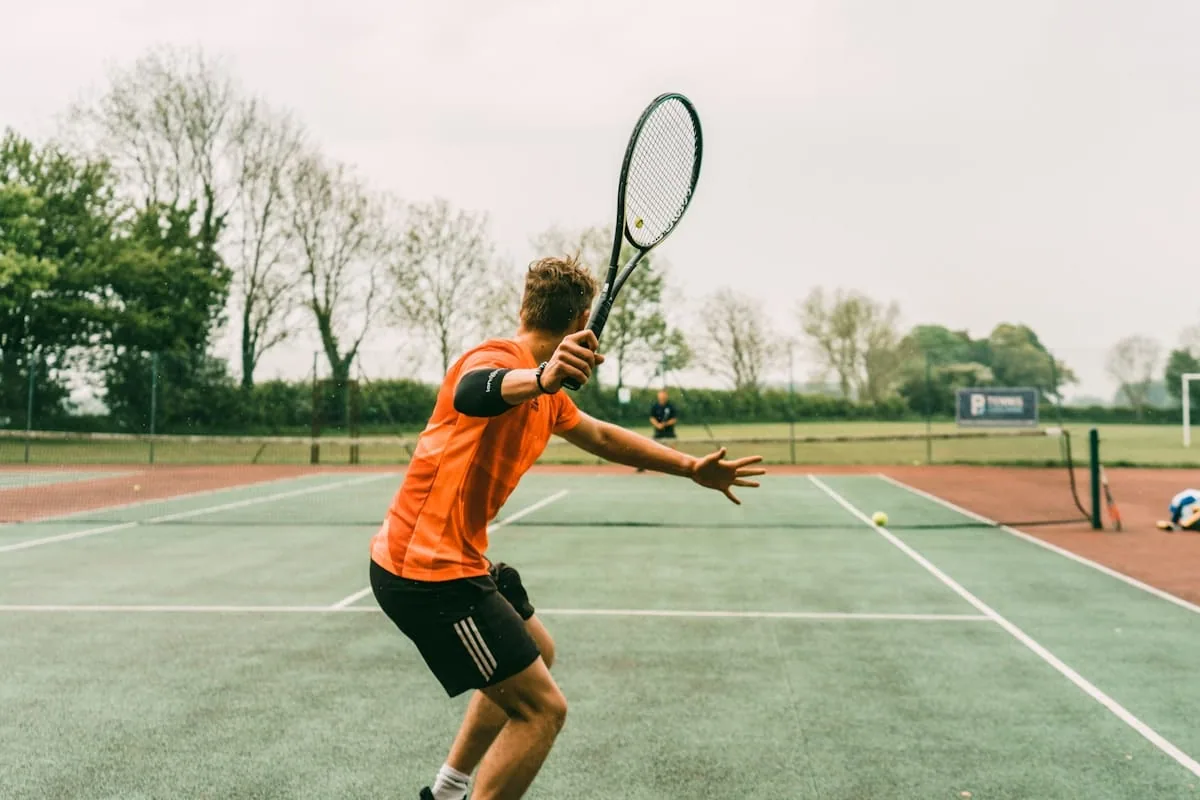
Photo: a player mid-forehand on an outdoor court, from our picture library.
🎾 Gear from this story
HeadHead Speed MPJannik Sinner's racket of choiceView on Amazon →As an Amazon Associate, SUPER.TENNIS earns from qualifying purchases.